



.svg)




Winning back three hours a week for Catch22 caseworkers
How Catch22 caseworkers improved the quality of their conversations and case notes with Beam's tools.
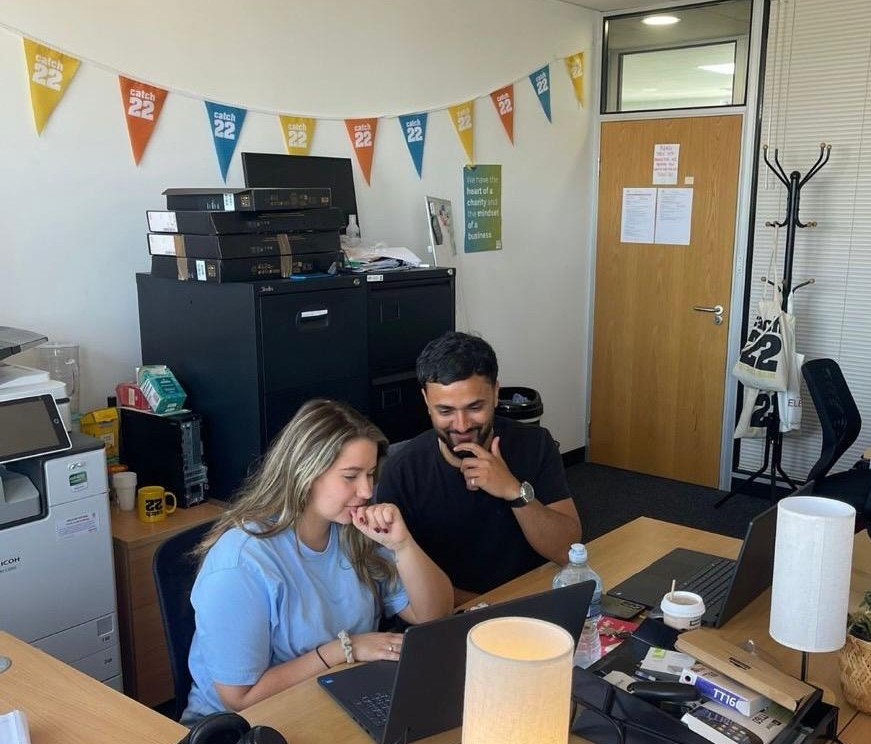
Catch22 delivers public services across England and Wales in justice, education, employment, and social care, including support for victims of crime.
Caseworkers at Catch22 have complex, often deeply personal sessions with the people they support. They also have to write up an overview of each session, covering what was discussed and any actions agreed.
Many caseworkers found themselves splitting their attention between listening and note-taking, or trying to remember the details to write up later.
Catch22 wanted to see whether Beam Notes could free up note-taking admin and help caseworkers focus fully on the people they support.
The challenge
Too much time spent on admin
Staff across justice and victim services told us that case recording and admin can be time-consuming. They wanted to spend less time behind a screen and more time with service users, providing quicker access to support, more meaningful engagement, and better outcomes for the people they work alongside.
Entering the same information twice
In some contracts, staff are required to use separate systems to record information. So many caseworkers had to enter the same information into two separate systems for every case.
Team wellbeing
Caseworkers carrying a heavy admin load found it harder to switch off and recover between sessions.
Quality of conversations
Staff had to divide their attention between engaging with service users and note taking. Some found themselves typing during sessions to capture the conversation, which prevented them from being fully present.
The approach
Catch22 tested several AI note-taking tools before choosing Beam. Beam's plans for the product matched where the team wanted to take the service.
Over 3 months, caseworkers trialled Beam Notes using a range of templates, including initial assessment, end of service, general meeting, and case note formats. Beam's team refined these throughout the pilot based on direct caseworker feedback, moving the language to first person and adding both a disclaimer statement and CAPTR scores for initial assessments.
Beam built the pilot to fit around Catch22's existing systems, so caseworkers on these services no longer needed to enter the same information twice.
Usage grew steadily throughout the pilot. Over 90% of caseworkers used Notes 10 or more times, with a strong cohort of super users recording up to 4 hours of conversations a week. In total, caseworkers recorded 978 sessions, totalling 351 hours.
The impact
3 hours back, every week
Caseworkers saved an average of 3 hours a week on admin and writing up tasks, and told us where that time went. 13 of 17 staff said they used it to spend more directly with the people they support, or to bring more depth to their work.
As one caseworker put it, "I can complete tasks more thoroughly and ensure my overall work is of a higher standard, focusing more attention on the areas of practice that require deeper input and professional judgement."
Caseworkers also used the time freed up for other essential admin, from emailing courts and local authorities to making referrals.
Others used it to protect their wellbeing. One caseworker said the time let them focus on "not getting burnt out, spending time with family and friends, connecting with colleagues."
Documentation caseworkers can stand behind
Caseworkers rated the quality of Beam Notes summaries at 8.7 out of 10 on average, and said the extra detail made a real difference to their work. Their ability to record key details from conversations increased from 23% to 100% when they used Notes.
Some caseworkers pointed to repetition in general meeting summaries as an area for improvement. Beam's team used that feedback to build a bespoke, Catch22-specific general meeting template with the right level of detail for check-ins.
More present, human conversations
With note-taking handled in the background, caseworkers who felt present and engaged during conversations increased from 18% to 100%. They said sessions felt "more personal" as they were able to provide eye contact and focus on the service users.
"It made sessions feel more genuine, rather than like you're there to do a job."
A tool people didn't want to give up
By the end of the pilot, every caseworker in the pilot group wanted to keep using Notes. Caseworkers rated ease of use at 9.6 out of 10 on average, and 76% rated the level of support from Beam's team as "excellent."
Benefits for neurodivergent staff
For some caseworkers, Notes did more than save time. It changed how sustainable the job felt, day to day. Two caseworkers in the pilot group, who identify as neurodivergent, described a real reduction in mental strain.
Shauna said the tool had reduced the mental pressure she felt throughout the day: "I don't have the stress of this anymore, and it reduces the pressure I feel."
Nicole said it had transformed her supervisions: "I can be properly present with them, keep eye contact and trust that the notes are being formulated without me needing to keep one part of my brain in the room, and one on my notes. It's been a huge relief."
Reducing the cognitive load of documentation helped these caseworkers stay in roles they found meaningful.
Looking ahead
Following the pilot's success, Catch22 has rolled out this pilot across its justice divisions, extending the tool from the original FBD pilot group to over 240 staff across justice, victim services.
Catch22 and Beam are also exploring Talk, Beam's voice AI tool, as a next step once the wider Notes rollout beds in, and continuing a co-design partnership to shape future product development together.
Give your caseworkers more time for the people they support
Book a demo to see how Beam’s tools could work in your organisation.

.gif)


